Who built bridges like this?
A king with no kingdom
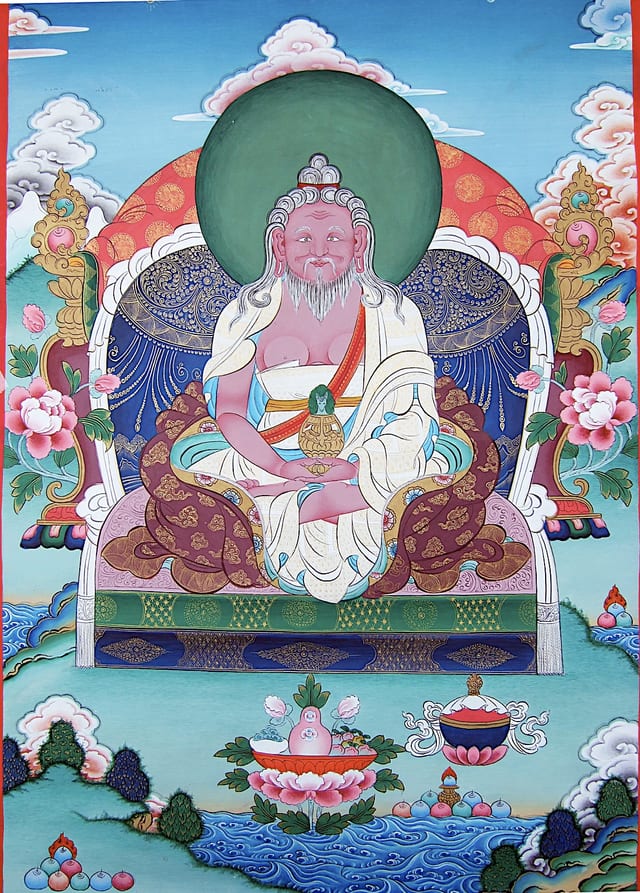
His name was Thangtong Gyalpo (ཐང་སྟོང་རྒྱལ་པོ་) — “King of the Empty Plain.” Born in upper Tsang around 1385, he grew into one of the most extraordinary people in Tibetan history: a Buddhist yogi and a physician, a sculptor and a blacksmith, and above all a brilliant engineer.[1, 2] Tibetans simply called him Chaksampa (ལྕགས་ཟམ་པ་), “the iron-bridge man.”
Tradition tells that he watched too many pilgrims and traders drown in Tibet’s freezing, fast rivers — once, the story goes, a ferryman turned him away for looking like a wild beggar. So he made a vow: he would chain the rivers with iron so that anyone, rich or poor, could cross in safety.[2, 5] (How much is history and how much is legend, we can’t be sure — his life was written down as the story of a saint.)
Why a bridge was everything
Crossing the river
Imagine a river as wide as a few football fields, grey with glacier melt, so cold and fast it can sweep a yak off its feet. For most of Tibetan history, to cross one meant a tiny hide boat, a risky ford, or a long walk to find a shallow place. People drowned. Trade stalled. Pilgrims couldn’t reach holy mountains.
A bridge changed all of that at once. Salt, wool and tea could move on the backs of yaks; families could visit; pilgrims could pray. To Thangtong Gyalpo, building a bridge wasn’t only clever engineering — it was an act of compassion, a gift to every traveller who would ever come after him.[1]
Tibetan ingenuity
Genius forged in iron
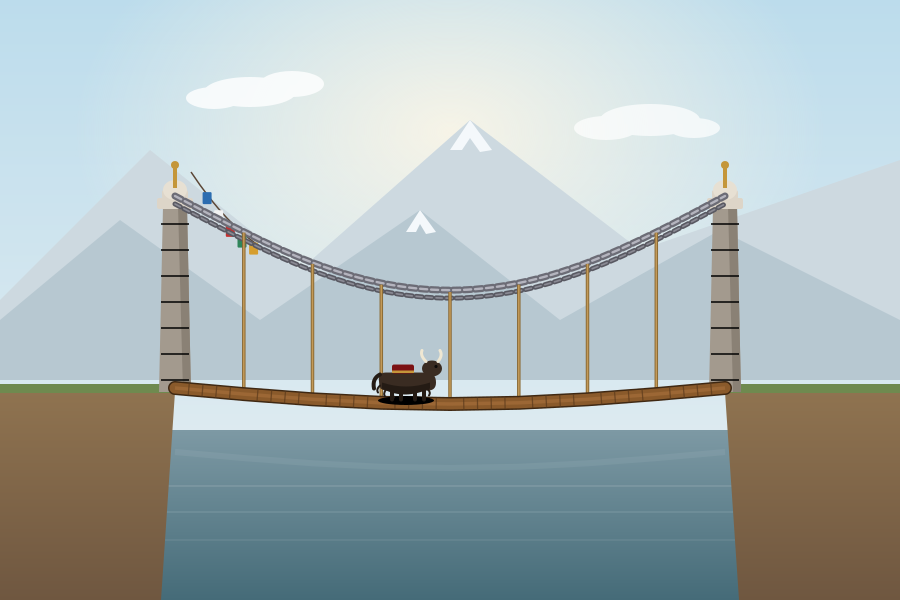
Here is the clever part — the part you’ll play. You can’t lay a plank straight across a huge river; nothing is stiff or long enough, and it would snap. So Thangtong Gyalpo did something much smarter. He smelted his own iron and hand-forged it into long chains. Two heavy chains were slung across the gorge and anchored into stone piers. From them hung ropes, and on the ropes rested a path of wooden planks. The iron carries the weight; the planks are just where your feet go.[3, 1]
- Iron chains — the strong, heavy spine that bears all the load. They can pull, but never push.
- Rope hangers — light ropes that hang the walkway from the chains and pull it flat.
- Wooden planks — the path underfoot. They hold no weight of their own; they only rest on a chain.
- Stone chortens — the masonry piers the chains anchor into at each bank.
His longest bridge, the Chushul Chaksam over the mighty Yarlung Tsangpo (built in 1430), spanned about 140 metres — believed to be the longest unsupported bridge anywhere in the world at the time.[3] These bridges were so light and lively they swayed underfoot like a trampoline — so much so that animals were often led across a separate bridge of their own. A yak, it turns out, is a fussy customer.[5]
Where did the money come from?
Singing up a bridge
Iron was precious, and hauling and forging it cost a fortune. So Thangtong Gyalpo had one more astonishing idea — and it had nothing to do with engineering. He is remembered as the founder of Ache Lhamo, Tibetan opera. The tradition tells that he gathered seven sisters, so graceful on stage that audiences called them lhamo, “goddesses,” and taught them to sing and dance the great Buddhist stories.[4]
The virtuous circleThe opera troupes travelled village to village and performed. People loved the shows and donated iron and money. That iron was forged into chains — and the chains became bridges. Art paid for engineering, and engineering carried the people across.
To this day Thangtong Gyalpo is honoured on the Tibetan opera stage as the white-bearded “god of drama,” and Ache Lhamo is performed across the Tibetan world. (Scholars treat him as the much-loved patron and traditional founder of the form rather than a documented author of it — but every opera troupe still begins by remembering him.)[4, 1]
What he left behind
Fifty-eight bridges
Over a long life, tradition credits Thangtong Gyalpo with 58 iron-chain bridges, 60 wooden bridges, 118 ferry crossings and 111 stupas.[1] Some of his iron still survives. The Tachogang bridge in Paro, Bhutan, was rebuilt in 2005 reusing its original links — hand-forged hooks of iron more than five hundred years old, still strong.[5] The puzzle you’re about to solve is a real engineering wonder, dreamed up by an ancient Tibetan genius — and paid for with a song.
References
The story above follows these sources — the scholarly biography first, with encyclopaedic and popular guides for cross-reference.
- [1]Stearns, C. (2007). King of the Empty Plain: The Tibetan Iron-Bridge Builder Tangtong Gyalpo. Snow Lion / Shambhala.Scholarship
Translation of the main Tibetan biography — the authoritative source for his life, the bridge numbers and the engineering.
- [2]Wikipedia (2024). Thang Tong Gyalpo. encyclopedia entry.Reference link
- [3]Wikipedia (2024). Chushul Chakzam. encyclopedia entry — the 1430 bridge over the Yarlung Tsangpo.Reference link
- [4]Wikipedia (2024). Lhamo (Tibetan opera). encyclopedia entry.Reference link
Records the opera-founding and seven-sisters story as tradition, not documented history.
- [5]Daily Bhutan (2020). Thangtong Gyalpo, the legendary iron-bridge builder of Bhutan. popular history of the Tachogang bridge.Popular link
A note on history and legend: Thangtong Gyalpo’s life was written down as a saint’s story, so dates and details vary (his lifespan is given as both c. 1385–1464 and the traditional 1361–1485), and the founding of opera is honoured tradition more than documented record. The engineering, the bridges and the surviving iron, however, are very real.